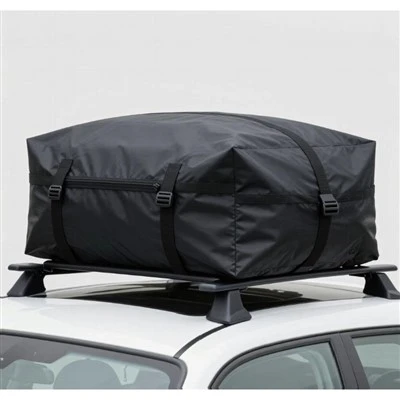
A vehicle roof cargo bag is normally specified by usable internal volume, not its nominal bag dimensions. For B2B sourcing, a 15 to 20 percent allowance should be deducted from theoretical volume because soft-sided bags deform under load and cannot be filled to a rigid rectangular envelope.
For an SUV roof bag, the practical design target is therefore a combination of usable volume, cross-bar compatibility, roof load rating, seam strength, waterproof construction and aerodynamic drag, rather than capacity alone.
1,40 to 80 Inch SUV Roof Bag Capacity Calculation
1.1 600 to 1500 Liter Capacity Formula
For an approximately rectangular soft cargo bag, the theoretical volume can be calculated as:
Volume (L) = Length × Width × Height ÷ 1,000
Dimensions must be measured in centimeters.
For example, a cargo bag measuring 110 × 85 × 45 cm has a theoretical envelope of:
110 × 85 × 45 ÷ 1,000 = 420.75 L
However, the actual loading capacity will be lower because of rounded corners, tapered geometry, zipper construction and material deformation.
| Bag Size | Theoretical Envelope | Recommended Usable Capacity | Typical SUV Application |
| 90 × 75 × 35 cm | 236 L | 190–205 L | Compact SUV |
| 100 × 80 × 40 cm | 320 L | 255–275 L | Compact SUV |
| 110 × 85 × 45 cm | 421 L | 335–360 L | Mid-size SUV |
| 120 × 90 × 45 cm | 486 L | 390–415 L | Large SUV |
| 130 × 90 × 50 cm | 585 L | 465–500 L | Full-size SUV |
| 140 × 95 × 50 cm | 665 L | 530–565 L | Large SUV |
The final BOM should therefore specify both nominal capacity and tested usable capacity. Using only the nominal volume can create discrepancies between product listings, carton specifications and customer expectations.
1.2 20 to 25 Percent Loading Allowance for Soft Bags
A soft roof bag should not be packed until the top panel is completely rigid. Overfilling increases zipper stress, seam loading and aerodynamic height.
For production control, JHTC can establish a loading specification such as:
- 80 to 85 percent maximum practical fill rate
- 10 to 15 kg recommended load per individual packing zone
- 20 to 30 kg total load for standard SUV application
- Load distribution within ±10 percent between front and rear sections
The actual maximum payload must remain below the vehicle manufacturer's roof load rating and the load rating of the roof rack or cross bars.
2,40 to 60 kmh Wind Speed Requires Controlled Aerodynamic Geometry
2.1 0.30 to 0.45 Drag Coefficient Target for Low Profile Bags
Aerodynamic resistance can be estimated using:
Fd = ½ × ρ × Cd × A × V²
Where:
- Fd = aerodynamic drag force
- ρ = air density, approximately 1.225 kg/m³ at standard conditions
- Cd = drag coefficient
- A = frontal projected area
- V = vehicle speed in m/s
A roof bag with excessive height produces greater frontal area and turbulent airflow. This directly increases fuel consumption and wind noise.
A practical OEM design should therefore keep the front section low and progressively increase the cross-sectional height toward the center of the bag.
| Design Parameter | Recommended OEM Range | Engineering Effect |
| Front height | 100–180 mm | Reduces air separation |
| Maximum center height | 300–500 mm | Controls cargo volume |
| Rear taper angle | 15–30° | Reduces wake turbulence |
| Front radius | ≥80 mm | Reduces sharp airflow separation |
| Bag width | 750–950 mm | Maintains SUV cross-bar coverage |
| Cross-bar spacing | 600–1000 mm | Depends on vehicle application |
| Target Cd | 0.30–0.45 | Design-stage aerodynamic target |
These figures are design targets rather than universal certification values. Final aerodynamic performance should be validated against the intended vehicle platform.
2.2 30 to 40 mm Clearance Around Cross Bar
Cross-bar compatibility should be controlled during pattern development.
The bag should provide sufficient clearance around the mounting straps without allowing excessive lateral movement. A production drawing should specify:
- Cross-bar width range
- Cross-bar spacing rang
- Strap position tolerance
- Buckle location
- Bottom reinforcement dimensions
- Anti-slip panel dimensions
For a multi-vehicle SKU, the mounting system should be tested against representative OEM cross-bar profiles, including round, square and aerodynamic bars.


For buyers sourcing multiple vehicle applications, see the complete Car Roof Bag product range for available roof cargo bag configurations.
3. 840D Oxford Fabric Versus PVC Coated Fabric for 1000D Class Applications
3.1 500D to 1000D Fabric Construction
The outer shell material directly affects abrasion resistance, tear strength, folding durability and waterproof performance.
Common commercial constructions include 500D PVC-coated polyester, 600D Oxford fabric, 840D Oxford fabric and 1000D PVC-coated polyester.
| Material | Typical Construction | Waterproof Method | Abrasion Resistance | Folding Flexibility | Typical Application |
| 500D PVC Polyester | 500D polyester + PVC | RF welding | High | Medium | Entry roof bags |
| 600D Oxford | 600D polyester | PU/PVC coating | Medium–High | High | General SUV bags |
| 840D Oxford | 840D polyester | TPU/PU coating | High | High | Premium OEM bags |
| 1000D PVC Polyester | 1000D polyester + PVC | RF welding | Very High | Medium | Heavy-duty cargo bags |
| TPU Coated Nylon | 840D–1000D nylon | TPU coating + welding | High | High | Lightweight premium designs |
Fabric denier alone does not determine final product performance. Coating thickness, yarn density, tear resistance, hydrostatic pressure and seam construction must also be included in the BOM.
3.2 IPX6 Waterproof Construction With High Frequency Welding
For a waterproof roof cargo bag, the weakest point is usually not the coated fabric. It is the seam, zipper, buckle penetration or mounting interface.
High-frequency welding can produce continuous welded seams on compatible PVC materials. TPU systems can also be engineered for welded construction when the fabric and equipment are correctly matched.
A production specification may include:
- IPX6-style water ingress target
- Continuous welded seams
- 50–70 mm reinforced bottom panels
- Double-layer strap attachment zones
- Waterproof zipper or roll-top closure
- 20–30 mm seam overlap
- 2–3 stitch rows where mechanical stitching is required
The exact IP rating should only be claimed after testing the finished product under the applicable test procedure.
4. 100 to 300 N Strap and Seam Load Testing
4.1 25 to 50 mm Webbing for Roof Bag Mounting
Mounting straps transfer vehicle acceleration, braking and lateral forces directly into the bag structure.
For OEM production, common webbing widths are 25 mm, 38 mm and 50 mm. Wider webbing distributes load across a larger fabric area and reduces local stress.
| Component | Typical Specification | Production Control |
| Webbing | 25–50 mm polyester | Width ±1 mm |
| Buckle | POM or reinforced polymer | Load test required |
| Reinforcement patch | 2–3 fabric layers | No exposed stitching edge |
| Strap stitching | Box X or multi-row | Stitch density controlled |
| Anchor point | ≥50 × 80 mm | Pull test required |
| Seam allowance | 15–25 mm | Pattern-controlled |
| Webbing tensile test | Project-specific | Batch sampling |
The final pull-test value should be defined according to the bag's maximum rated payload and mounting architecture rather than using one universal number.
4.2 500 to 1000 Hour UV and Folding Durability
Outdoor roof bags are exposed to UV radiation, temperature cycling, rain, road dust and repeated folding.
A procurement specification should include accelerated testing where required:
- UV aging
- Hydrostatic water resistance
- Seam leakage
- Buckle tensile testing
- Webbing tensile strength
- Repeated folding
- Abrasion testing
- Low-temperature flexibility
- High-temperature storage
For export programs, the testing protocol should be agreed during the BOM approval stage, rather than after mass production.
5. ±5 to ±10 mm OEM Dimension Tolerance
5.1 1000 mm Length With ±10 mm Production Tolerance
Soft products require different dimensional tolerances from injection-molded or CNC components.
For an OEM roof bag, a practical drawing may specify:
| Dimension | Typical Tolerance | Inspection Method |
| Overall length ≤1000 mm | ±10 mm | Flat measurement |
| Overall width ≤900 mm | ±8 mm | Flat measurement |
| Overall height | ±10 mm | Loaded fixture |
| Webbing width | ±1 mm | Vernier/caliper |
| Reinforcement position | ±5 mm | Pattern template |
| Buckle position | ±10 mm | Assembly fixture |
| Zipper length | ±5 mm |
Tape measurement |
Tolerance must be attached to a defined inspection condition. Measuring an empty soft bag and measuring a fully loaded bag will produce different results.
5.2 3 Week Prototype Lead Time for OEM Development
A controlled OEM development process should separate design approval from production approval.
| Development Stage | Typical Lead Time | Main Output |
| Technical brief | 1–3 days | Product specification |
| Pattern development | 3–5 days | 2D pattern |
| Material confirmation | 3–7 days | BOM |
| Prototype | 7–10 days | Physical sample |
| Load and waterproof testing | 3–7 days | Test report |
| Revision | 3–5 days | Final sample |
| Pre-production approval | 2–3 days |
Golden sample |
A straightforward design can reach prototype approval in approximately 3 weeks. New tooling, custom buckles, special fabrics or vehicle-specific mounting systems can extend the schedule.
6,MOQ and FCL Loading for China OEM Supply
6.1 20 Foot and 40 Foot Container Packing Optimization
Roof bags are volumetric products. Carton dimensions can consume more freight capacity than the folded product itself.
For container planning, the purchasing team should evaluate:
Carton CBM = Length × Width × Height ÷ 1,000,000
| Packaging Parameter | Typical OEM Target |
| Folded bag thickness | 80–150 mm |
| Individual carton | 0.03–0.08 m³ |
| Retail packaging | 1 unit per carton |
| Master carton | 4–10 units |
| Carton utilization | ≥85% target |
| Palletized loading | Project dependent |
Final FCL quantity should be calculated from the approved carton dimensions rather than estimated from product dimensions.
This is particularly important for distributors purchasing several roof bag sizes under one purchase order.
7. What Global Buyers Should Put Into the OEM BOM
7.1 840D Fabric, ±10 mm Tolerance and IPX6 Testing
A useful OEM BOM should contain measurable specifications instead of descriptions such as "high quality" or "heavy duty."
Recommended BOM fields include:
- Fabric composition and denier
- Coating type and thickness
- Fabric weight in GSM
- Seam construction
- Welding temperature and pressure where applicable
- Zipper specification
- Webbing width and tensile strength
- Buckle material
- Reinforcement dimensions
- Product dimensions
- Empty weight
- Tested usable capacity
- Maximum rated payload
- Packaging dimensions
- Carton CBM
- Applicable test standards
- Inspection sampling plan
For B2B procurement teams, this BOM becomes the reference document for quotation comparison, sample approval and mass-production inspection.
8. China SUV Roof Cargo Bag Manufacturer With OEM Engineering Support
JHTC OUTDOOR PRODUCTION CORP approaches roof cargo bags as soft-structure load-bearing products rather than simple sewn bags. The production specification should connect material selection, aerodynamic geometry, mounting load, waterproof construction, dimensional tolerance and packaging efficiency in one BOM.
For distributors and outdoor brands comparing a [Insert Link: waterproof SUV roof bag manufacturer], the quotation request should include vehicle type, required capacity, cross-bar dimensions, target material, annual volume and destination market.
Request an OEM quotation with your target capacity, fabric specification and annual purchasing volume. A technical quotation should include BOM details, prototype lead time, MOQ, packaging CBM and available testing options.